Live-Camera Betting Explained: CCTV Betting Games for Operators (2026 Guide)
What live-camera betting (CCTV betting) is, how AI-written markets on live cameras are priced and settled, how it differs from counting games and virtual sports, and how an operator integrates it.

TL;DR
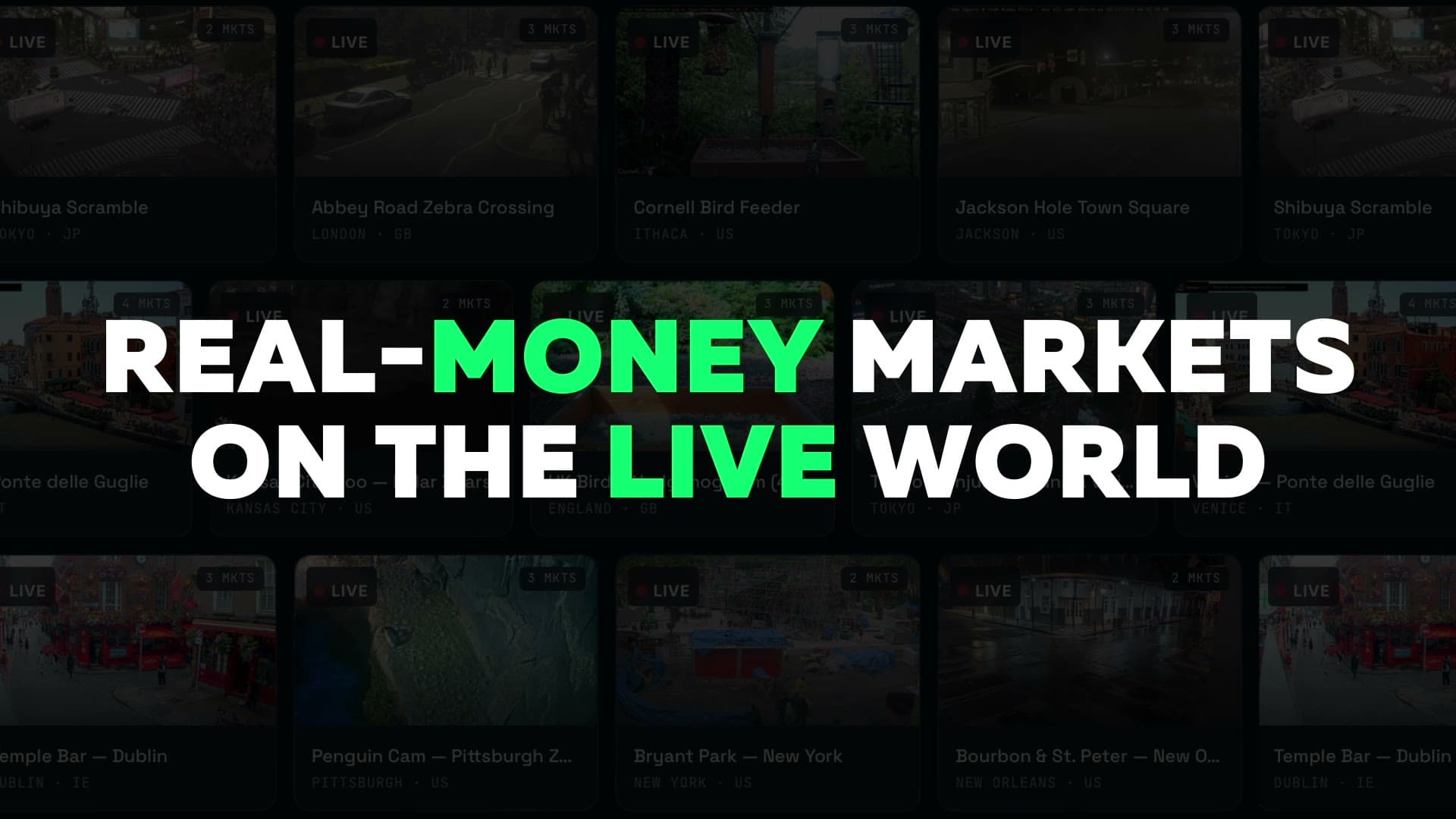
Live-camera betting — the trade press calls it CCTV betting or CCTV games — lets players bet on what happens next on a live public camera: a bus at a junction, a bird at a feeder, a gondola under a bridge. The first commercial titles, launched in early 2026, are counting games (how many cars cross a zone in about a minute). The second format, Lukk by Adkuu, uses an AI that writes a natural-language question from the scene, prices it live, and lets the camera settle it from signed evidence frames within seconds. For operators the appeal is structural: real events with no sports rights, no leagues, no athletes and no random number generator; a new market every minute or two; and a B2B delivery that works like any other game provider — a widget or a feed on the operator's own wallet, with the operator's own margin.
Key takeaways
- Live-camera betting is a real event with betting semantics: the content is a live camera, the market is a short question about the next minute or two, and the result is decided by what the camera recorded.
- Two formats exist as of October 2026: fixed-shape counting games (over/under/range/exact on an AI tracking zone) and AI-written markets in several shapes (race, first-to, count, happen, state-at-close) priced as YES/NO with locked odds.
- Settlement quality is the whole product. Look for a frozen, hashed rule before the first bet; signed deciding frames; a replay behind every result; and a void policy that refunds in full when the camera cannot tell.
- Integrity comes from design, not trust: rotating channels nobody can camp, bets that close before the window begins, an acceptance delay with an in-flight veto, limits, liability caps and circuit breakers.
- Integration is the familiar game-provider pattern: an iframe widget launched with a single-use session (an afternoon) or a raw feed over REST, WebSocket and gRPC (days), with a seamless wallet on the operator's side. Lukk's published commercial model is revenue share, 5–8% of GGR, no upfront fees.
What live-camera betting is — and the names it goes by
The format has several names because it is new. CCTV betting and CCTV games are the terms the 155.io studio and the trade press attached to the first counting titles. Live-camera betting, live camera markets and webcam betting describe the same idea from the player's side. Adkuu calls its own product a live-world betting feed: the live stream, the AI-written markets, the prices, the settlement and the risk controls, delivered as one feed.
Whatever the name, four things define the category:
- The content is a live public camera — a street crossing, a harbour, a container port, a bird feeder, a wildlife pool — not a studio, not a simulation, not a sports broadcast.
- The market is short. A round lasts about a minute or two. In Lukk a new market opens every minute or two and a round is roughly 90 seconds.
- The camera decides. There is no random number generator and no referee. The frames everyone watched are the evidence.
- It is supplied B2B. The product is run by licensed operators under their own brand, like a virtual-sports feed or a live-casino provider, not as a consumer app.
It is useful to be clear about what it is not: it is not in-stream sports betting (odds laid over a football broadcast, which needs rights and official data), not sports micro-betting (next-play markets inside a match), not a crash game (an RNG multiplier curve) and not virtual sports (a scheduled RNG simulation). Those products can sit in the same lobby; they are different things.
How a round works
The worked example below is Lukk's flow. Counting games follow the same skeleton with a fixed question.
| Step | What happens | What decides it |
|---|---|---|
| 1. The scene | A public camera streams a crossing, a harbour or a feeder. In Lukk, players watch channels — synchronized rotating broadcasts — not a camera they pick. | The schedule |
| 2. The lens | A vision layer tracks every car, bus, bird and pedestrian in frame and what each is doing. Players see the same boxes the oracle judges. | Deterministic tracking |
| 3. The question | An AI reads the scene and writes a question anyone can answer at a glance — "Will a bus cross the junction before the light turns red?" — then prices it live. The rule is frozen and hashed before the first bet. | The market-authoring model |
| 4. The call | A player backs an outcome at a locked price. The ticket is accepted after a one-to-three-second delay with an in-flight veto; payout is stake × odds, exactly, up to ×20. | Acceptance pipeline |
| 5. The proof | The window closes; the deciding frames are locked, signed and published with the result; the ticket settles within seconds (larger payouts carry a short verification hold). If the camera cannot tell, the market is voided and every stake refunded. | The camera, via a deterministic counter or a vision judge |
Five market shapes cover most of what a camera can show. Race: will a bus cross before the light changes? First to: which lands first — a cardinal, a blue jay, or neither? Count: will 10 or more people be on the crossing in 120 seconds? Happen: will a gondola pass under the bridge before any motorboat? State at close: will the crane be lifting at zero?
Two formats on the market in 2026
| Counting games (155.io's "CCTV Game: Rush Hour") | AI-written markets (Lukk by Adkuu) | |
|---|---|---|
| The question | Fixed: how many objects cross a designated AI tracking zone in a set period | Written by an AI from the live scene, in natural language, in five shapes |
| The bet | Over, Under, Range or Exact on the count | YES/NO (some markets add "Neither") at a locked price; house fixed odds or a fair-curve mode |
| The scene | Cities such as Tokyo, Lyon, Sydney and London, selected automatically by time of day and traffic | Rotating channels — streets, crossings, nature, water, ports, wildlife — so nobody can camp a camera |
| Settlement | The AI count of objects that crossed the zone | Signed, published deciding frames; deterministic counter or vision judge; replay behind every result; ambiguous evidence is voided |
| Distribution | Direct integrations with Stake, Roobet and Shuffle (February 2026); Hub88 as exclusive aggregation partner (announced 26 February 2026) | Direct B2B integration: iframe widget or feed, on the operator's wallet; early access, onboarding first operators (October 2026) |
Both are legitimate design choices. The counting format is instantly legible and fits a casino lobby's quick-game pattern. The AI-written format behaves like a fast prediction market and fits a sportsbook's trading model, because the operator controls the margin and sees the exposure.
Why operators are looking at it
Rights-free content. Sports content keeps getting more expensive and more contested. A public camera has no league, no data rights holder and no athlete. The supply is effectively infinite and the cadence is set by the camera, not by a fixture list.
Cadence without a studio. Live game shows need presenters and sets; virtual sports need a simulation schedule. A camera is always on, and in a channel model there is always a round in play.
A different kind of engagement. The player is watching something real and the question is about that reality. Lukk's design brief puts it as "no form guide, no insider edge — just eyes and reflexes."
It fits existing plumbing. The integration is the game-provider pattern operators already run: launch a session, debit and credit through the operator's wallet, receive settlements.
Settlement: the camera is the oracle
Settlement is where live-camera betting is won or lost, because the operator inherits every dispute. Lukk's published mechanics are a useful checklist for evaluating any product in the category:
- A frozen rule. The settlement rule of each market is hashed before the first bet; every ticket carries the
rule_hashit was graded by. - Signed evidence. When the window closes, the deciding frames are locked, signed (ed25519) and published with the result.
- A deterministic path first. Where a counter or tracker can decide (a count, a crossing), it does; the vision judge handles the rest. The settlement line tells the operator which source decided.
- A replay behind every result. Players and operators can review the frames that settled the market.
- Voids are full refunds. If the camera cannot tell, the market is voided and every stake is refunded — never re-graded in anyone's favour. Post-settlement corrections are rare, audit-driven, and visible as a reversal in the operator's wallet log.
- Speed. Markets settle within seconds of close (Lukk's published figure is a median under five seconds, with a short hold on larger payouts), and the operator receives a signed settlement webhook plus a pull endpoint with totals for netting.
Integrity: what an attacker tries, and what stops it
The question press analysts have asked about the genre — can someone standing at the camera influence the result? — has an engineering answer.
| Attack | Defence in Lukk's design |
|---|---|
| Stand at the scene and act | Bets close before the window begins, so the actor has not seen the outcome either; stake caps make rigging uneconomic; anomaly profiling flags coordinated accounts |
| Camp one camera and learn its patterns | Players watch rotating channels; nobody picks or keeps a camera, and a skip vote can only bring the scheduled next scene forward |
| Bet late on a delayed stream | A one-to-three-second acceptance delay with an in-flight veto from the tracker; price protection; oracle-lag measurement refuses a player whose stream is behind |
| Exploit a stale price | Quote expiry, suspension on decisive events and stale prices, per-outcome liability caps, circuit breakers |
| Dispute an ambiguous frame | The rule hash, signed frames and replay settle the argument; ambiguous evidence is voided and refunded |
Privacy and the compliance split
Press coverage has also raised privacy: laws on filming public spaces differ by country. A product in this category should be designed so that no face is needed to settle a market, so that person labels never carry descriptors that could identify or profile people (Lukk's labels never carry colour qualifiers), and so that the supplier holds no player data at all — Lukk receives an opaque player_ref and never a name, an email or a balance.
The regulatory split is the familiar supplier model. The operator holds the consumer licence and its duties: KYC, AML, age verification, responsible-gambling limits and self-exclusion (passed as ticket context and enforced by Lukk's acceptance pipeline), geofencing, terms and disputes. The supplier stays PII-free, enforces per-ticket limits, controls which markets an operator may serve by jurisdiction, and carries settlement integrity. Regulatory classification of camera-resolved event contracts differs by jurisdiction and is worked through per market with the operator's legal team; Lukk carries supplier KYB, licensing and certification tracks on its side. No product in this category should be sold as "legal everywhere".
Integrating it: widget or feed
Lukk publishes two paths that share one identity model, one wallet contract, one risk engine and one settlement backbone.
A. The widget (iframe) — an afternoon. The operator's backend mints a single-use launch session (POST /api/v1/b2b/embed/sessions with its operator key; the token expires after 120 seconds). The returned launch_url is the iframe source. The widget is locked to the operator's registered origins by a per-operator frame-ancestors policy, takes the operator's theme (semantic colours, typography, corner radius, stake presets), and talks to the page over a postMessage bridge: lukk:ready, lukk:bet, lukk:session_expired, lukk:relaunch_request and lukk:error out; lukk:relaunch, lukk:theme and lukk:refresh_balance in. If the API is unreachable the widget still loads from a static edge and shows a calm "not available" screen.
B. The feed (REST, WebSocket, gRPC) — days. GET /api/v1/b2b/feed returns every open market with both views — fair probabilities and margined fixed odds — plus timing, status, limits and the frozen rule hash, and the latest settled markets. Live updates arrive on wss://api.lukk.gg/ws/v1 (topic b2b:feed) within a second, with resume after a reconnect, and a gRPC mirror for dedicated integrations. Betting is quote-to-ticket: GET /api/v1/b2b/quote/{slug} then POST /api/v1/bets, through the same acceptance gates.
The wallet. Lukk never holds player funds. It calls four endpoints on the operator's side — debit (synchronous and fail-closed: no debit, no bet; answer within five seconds), credit (queued and retried), rollback and a daily reconcile that alarms on any divergence and never auto-adjusts. Every call is HMAC-SHA256 signed with the operator key and carries an idempotency key; amounts are decimals with two places in the operator's currency.
Certification and commercials. Certification runs on a play-money account on the production surface; a dedicated sandbox host is on the roadmap. Lukk's published commercial model is revenue share, 5–8% of GGR, with no upfront fees.
Where it sits in a lobby
| Product | Source of outcomes | Cadence | Rights needed | What the operator controls |
|---|---|---|---|---|
| Live-camera betting (AI-written markets) | A real scene on a live camera | A new market every minute or two | None | Margin, limits, mode (house odds or fair curve), scenes to serve |
| Live-camera counting games | A real scene on a live camera | About a minute a round | None | Stake limits; prices set by the game |
| Virtual sports | RNG simulation | Scheduled | None | Stake limits |
| Crash games | RNG multiplier curve | Seconds to a minute | None | Stake limits |
| Live game shows / live dealer | Studio wheel or dealer | Minutes | None (studio costs) | Stake limits |
| In-stream sports betting | A real match | Match-paced | Sports rights and data | Margin, limits |
| Prediction markets (fixed-odds feed) | Real-world events | Hours to months | None | Margin, limits, topics |
Adkuu sells two of these rows: Lukk for live-camera betting and Adkuu Pulse for a fixed-odds prediction-markets feed — one partner, one integration pattern.
What to ask a provider
- Is the settlement rule frozen and hashed before the first bet, and does every ticket carry it?
- Are the deciding frames signed and published, with a replay?
- What happens when the camera cannot tell — is the market voided and fully refunded?
- How does the product stop camping, late bets and delayed streams? Ask for the acceptance delay, the in-flight veto and the oracle-lag policy.
- Which pricing modes exist, and who sets the margin?
- Widget, feed or both — and is the wallet seamless, signed and idempotent?
- What does the operator receive at settlement (webhook, pull endpoint, totals for netting)?
- What player data does the supplier hold? (The right answer is none.)
- How is certification done, and what is the commercial model?
FAQ
Is live-camera betting the same as CCTV betting? Yes. "CCTV betting" and "CCTV games" are the trade-press names for betting on live public cameras; "live-camera betting" and "live camera markets" are the same category.
Is it a casino game or a betting product? It depends on the format. Counting games are distributed like casino games through aggregators. Lukk's AI-written markets behave like fast fixed-odds betting: the operator controls the margin and sees the exposure, and the feed can also run in a fair-curve mode.
How fast do markets settle? In Lukk, within seconds of the window closing — a median under five seconds, with a short verification hold on larger payouts.
Can an operator run it under an existing licence? Classification differs by jurisdiction and is worked through per market with the operator's legal team. The supplier model is the familiar one: the operator holds the consumer licence; the supplier stays PII-free and carries settlement integrity.
Where can I see it running? Lukk's live demo runs inside Adkuu Play exactly the way an operator would run it — launch link, seamless wallet, themed widget — with play money on a test network. The product site is lukk.gg; the operator detail is at lukk.gg/operators.
Sources
- Hub88 chosen as exclusive aggregation partner for 155.io's breakthrough CCTV game Rush Hour — iGB
- CCTV betting: Accessible innovation or an integrity nightmare waiting to happen? — Global Gaming Insider
- What Is Betting on Traffic and Where to Gamble on CCTV Traffic Footage? — Casino Guru
- AI-driven micro-markets: Betting on moments, not matches — Business Cloud
Last verified: October 10, 2026.